Claude for Financial Advisors is not compliant or non-compliant on its own. Anthropic's plugin drafts, summarizes and pre-screens, and its own disclosure leaves "supervisory review, recordkeeping, and compliance" with the firm. Before advisors connect it to client data, the CCO decides five things: which AI work becomes a record and where it is kept, Reg S-P oversight of Anthropic and each connector vendor, Marketing Rule review, a written AI policy, and accurate descriptions of how the firm uses AI.
If advisors will use it with client data, decide the plan, how any records get to your archive, and the AI policy before the first connection. Until those are in place, keep client data out of Claude and ChatGPT. The same goes for any AI vendor: before client data goes in, confirm in writing how that vendor protects it, how long it keeps it and whether it trains on it.
Anthropic launched Claude for Financial Advisors on September 14, 2026. If your advisors are asking to install it, or already have, this guide covers what you decide first, with the rule text behind each decision. Most of it applies equally to ChatGPT. We build compliance software for RIAs and are not affiliated with Anthropic or OpenAI. At the end, we explain how RegFin fills the gaps in using AI responsibly and compliantly, going further than Claude does on its own: an audit log of every request an assistant makes, access granted area by area, Marketing Rule review with CCO approval, and vendor oversight for Regulation S-P, all built into the app and available inside Claude itself.
What is Claude for Financial Advisors?
Claude for Financial Advisors is a free, open-source plugin for Claude with two parts. Connectors let Claude read the advisor's systems, and skills turn that data into work product. According to Anthropic's launch post, the connectors reach Addepar, BlackRock, Charles Schwab (not yet released), Envestnet (Tamarac and MoneyGuide), iCapital, Orion (including Redtail CRM), SS&C Black Diamond, Wealthbox, Wealth.com, Vanguard and Zocks.
The plugin repository lists eight skills: onboarding, pre-meeting prep, post-meeting notes, compliance, prospect intake, portfolio rebalance review, an alternatives brief, and an estate and tax brief. Several of them write back into client systems. The post-meeting skill turns a transcript into a CRM note, and the estate and tax brief can create CRM follow-up tasks. Anthropic says Claude "stages administrative actions like CRM updates or draft client communications" for the advisor to approve.
The repository describes the plugin as a "Reference implementation. Not actively maintained or monitored." Its compliance checklist and workflow instructions will not update themselves when rules or SEC guidance change, so if your firm uses them, someone has to review and maintain them.
A chat window that drafts a paragraph is one kind of risk. An assistant that reads custodial positions, writes CRM notes and drafts client emails is part of your books, your vendor list and your supervisory system.
Is Claude for Financial Advisors compliant?
Anthropic does not claim it is, and it puts the regulated decisions back on the firm. The launch post says "investment recommendations, client communications, compliance determinations, and other regulated activities remain subject to human review and approval." The plugin's disclosure goes further: "Users remain solely responsible for all investment decisions, client communications, supervisory review, recordkeeping, and compliance with applicable laws, regulations, and firm policies."
The SEC has not adopted an AI-specific rule for advisers either. In June 2025 the SEC withdrew its proposed rule on conflicts from predictive data analytics, along with its proposed outsourcing rule for advisers. What governs Claude at an RIA is the set of rules you already run: Rule 204-2 books and records, Regulation S-P, the Marketing Rule, and the Rule 206(4)-7 compliance program. The rest of this guide takes them one at a time.
Which AI work becomes a record under Rule 204-2?
Rule 204-2 does not mention AI. It lists the records an adviser must keep, and AI-assisted work falls into those categories based on what the conversation or document is about. Who wrote the first draft doesn't change the answer. The categories that come up most:
- Client emails Claude drafts. Paragraph (a)(7) requires originals of written communications the adviser receives and copies of those it sends relating to any recommendation made or advice given. For an email Claude drafted, the record is the email as sent. Your email archive should already capture it. The gap opens when an advisor copies a Claude draft into a personal text thread or an unapproved app, which is the off-channel problem in a new form.
- Marketing Claude helps write. Paragraph (a)(11) requires a copy of each advertisement the adviser disseminates.
- Your AI policy and its annual review. Paragraph (a)(17) requires the policies and procedures adopted under Rule 206(4)-7 and records documenting the annual review.
- CRM notes. Rule 204-2 does not name CRM notes. Many firms rely on them to show what was discussed and recommended, though. If yours does, a note written by Claude's post-meeting skill is a firm record under your own policy, and the CRM has to keep it.
- The chat itself. The SEC has not said that every AI conversation is a required record. Whether a given chat is one depends on what it contains, which is a call for you and counsel. Make that call before the chat is deleted, because deleted content may not come back.
Most required records are kept for at least five years, the first two in an appropriate office of the adviser. When the clock starts depends on the record: for most it is the end of the fiscal year of the last entry, and for an advertisement it is the end of the fiscal year it was last disseminated (paragraph (e)). For the wider picture, see our guide to what RIAs must archive under Rule 204-2.
What do Claude and ChatGPT keep?
Anthropic recommends Enterprise for RIAs "because it includes the audit logs that support recordkeeping." Those audit logs are narrower than the phrase suggests. Anthropic's audit log article says the export is available to Enterprise organizations only, covers the past 180 days, and excludes the titles and content of chats and projects.
The conversation content comes through a separate route, the Compliance API. Anthropic's Compliance API FAQ says its Activity Feed keeps six years of who-did-what-and-when but "does not capture the prompt text or model responses." Its chat, file and session endpoints return the content for Claude Enterprise organizations, and session transcripts include the tool calls Claude made and what came back. Content follows your organization's retention setting, which is indefinite by default, "unless a user deletes it sooner." A chat a user deletes still appears, but without its content, and Anthropic's advice is to "pull any content you need to retain (for legal hold or archival) while it is still available."
OpenAI's setup is similar, with a shorter window. Per OpenAI's help center, its Compliance Platform is available only to ChatGPT Enterprise and Edu workspaces. As of October 2026, its logs are kept for 30 days, and keeping them longer means downloading them continuously and storing them yourself. Deleted data cannot be recovered. OpenAI lists several archiving vendors that already integrate with the platform.
| Plan | Supported route for conversations into an archive | What the firm still does |
|---|---|---|
| Claude Free, Pro, Max | None. Consumer terms: each user decides whether chats train models | Keep client data off these plans |
| Claude Team | None. No audit logs, no Compliance API | Keep record-creating work off it, or capture those records another way |
| Claude Enterprise | Compliance API: chats, files, projects, session transcripts with tool calls. Audit-log export: 180 days, no chat content | Connect an archive and pull content before users can delete it |
| ChatGPT Free, Plus, Pro | None. Consumer plans | Keep client data off these plans |
| ChatGPT Business (formerly Team) | None. No Compliance Platform | Keep record-creating work off it, or capture those records another way |
| ChatGPT Enterprise, Edu | Compliance Platform, logs kept 30 days | Download continuously into an archive |
No rule requires an enterprise plan. What the rules require is keeping the records your advisors create. If AI conversations at your firm can contain records, enterprise plans are the only supported, automated way to capture them. On other plans, keep record-creating work such as client advice and client-facing drafts out of the chat, or capture those records another way. On any plan, someone at the firm or its archiving vendor has to pull and store what must be kept. RegFin does this for Claude Enterprise and ChatGPT Enterprise and Edu: it archives the chats for six years and keeps an archived chat even after a user deletes it. Pricing details are in the FAQ below.
How does Regulation S-P apply to Claude and its connectors?
When client information passes through Anthropic or a connector vendor, that company is generally a service provider under the amended Regulation S-P. The 2024 amendments require SEC-registered advisers to have written policies reasonably designed to require oversight of service providers through due diligence and monitoring, including so a provider notifies the firm no later than 72 hours after it becomes aware of a breach affecting a customer information system it maintains. Affected individuals generally must be notified as soon as practicable, and no later than 30 days after the firm becomes aware that their sensitive customer information was, or is reasonably likely to have been, accessed or used without authorization. Notice is not required if a reasonable investigation finds the information has not been, and is not reasonably likely to be, used in a way that would cause substantial harm or inconvenience. The compliance dates have passed. Advisers with $1.5 billion or more in regulatory assets under management had to comply by December 3, 2025, and smaller SEC-registered advisers by June 3, 2026.
For a Claude rollout, that means:
- Plan type is a data-handling decision. Anthropic says it does not train on inputs or outputs from its commercial products by default. Its consumer terms work differently. On Free, Pro and Max, each user chooses whether chats can train models. An advisor pasting client details into a personal Pro account is outside your vendor oversight entirely.
- The incident response program has to cover the new path. If a connector vendor or Anthropic has a breach that touches customer information, your 30-day clock and your 72-hour expectation of the provider both apply.
- Connections multiply vendors. One advisor connecting Claude to the custodian, the CRM and a planning tool creates three data paths through a fourth vendor. Each belongs in your vendor file.
State-registered advisers are not covered by Reg S-P. They fall under the FTC's Gramm-Leach-Bliley rules and state law instead. Our Regulation S-P guide covers the rule in full.
Does the compliance skill satisfy the Marketing Rule?
No, and it says so. The compliance skill checks client-facing material against the Marketing Rule, the antifraud provisions of Section 206, books and records, and Reg BI with FINRA Rule 2210 for dual registrants. It returns a table of findings rated Fail, Flag or Note, suggested disclosures and a clean redraft. It tells the advisor to send anything rated Fail, and anything involving performance, hypothetical performance or testimonials, to the CCO before it goes out.
The skill's instructions are clear about what it is not. Its output is "a draft review for the firm's CCO/compliance officer, not a legal determination or an approval." Its reference checklist is "a static snapshot, not a live firm-rules feed." It does not know your firm's required disclosures, banned phrases or approval matrix unless someone adds them.
That makes it a useful first pass for an advisor. The approval still belongs to the firm. Rule 206(4)-1 does not prescribe a review workflow, but Rule 206(4)-7 requires policies reasonably designed to prevent violations, and most firms meet that with compliance review of advertisements before use. Rule 204-2(a)(11) then requires keeping a copy of each advertisement disseminated. Decide where the advisor's pre-check ends and the formal review begins, and where the approved version and the decision are kept. Our Marketing Rule guide covers the rule in full.
What should your written AI policy cover?
Rule 206(4)-7 requires written policies and procedures reasonably designed to prevent violations of the Advisers Act, an annual review of their adequacy and effectiveness, and a designated chief compliance officer. Adding an AI assistant that reads and writes client data is the kind of change those policies should address.
Examiners will look. The SEC's fiscal 2026 examination priorities say the Division of Examinations "will review for accuracy registrant representations regarding their AI capabilities or AI" and "will assess whether firms have implemented adequate policies and procedures to monitor and/or supervise their use of AI technologies." The fiscal 2027 priorities, released October 23, 2026, go further: the Division says it "is intensifying its efforts to understand how the technologies influence outcomes and whether firms continue to comply with existing, technology-neutral obligations."
Anthropic's plugin includes what it calls a "self-guided AI-policy workflow that helps firms document their use of AI under SEC rules." It is a reasonable starting draft. The firm still adopts the policy, tests it and reviews it each year. A workable policy covers:
- Approved tools and plans. Which assistants, on which plans, and a ban on client data in personal accounts.
- Connections. Who may connect which systems, read-only or read-write, and who approves a new connector.
- Human review. What must be reviewed before it reaches a client, and by whom.
- Records. Which AI outputs are firm records, where each is kept, and how chats reach the archive.
- Testing. For example, a quarterly sample of AI-drafted client emails and CRM notes checked against what was sent and said.
- Disclosure. How the firm describes its AI use in Form ADV, on its website and in marketing.
- Training and annual review. Who is trained, and how the policy is reviewed under Rule 206(4)-7.
Our guide to writing an AI acceptable use policy for an RIA covers each section in more detail.
Put the approvals themselves in your testing plan. The plugin README says several of its safeguards, including asking the advisor before writing anything to the CRM or another system, are "enforced by the model following them, not by the runtime."
In plain terms, Claude has been told to ask first, and it usually will, but an instruction is not a guarantee. Whether a change can go through without the advisor's approval depends on the system on the other end, such as the CRM, and what it checks. An AI can misread its instructions, skip a step in a long task, or be steered by wording inside an email or document it reads, so a CCO should know where approval is enforced for each connection. That is a reason to give connectors read-only access where an advisor does not need to make changes, and to test that approvals happen in practice.
A connected system can do more than an instruction can. When an assistant asks RegFin to change something, RegFin shows the person the change first and makes it only after they approve. That check happens in RegFin, so the assistant can't skip it. For forms and marketing submissions, the person confirms in a RegFin panel inside the chat, and a firm can require every approval to come from a prompt in the assistant app that only a person can answer. Where RegFin fits covers the rest.
What has the SEC done about AI claims?
The SEC has already brought AI cases against advisers. Both were about what the firms said their AI did. In March 2024 it charged Delphia and Global Predictions with false and misleading statements about their use of AI, with penalties of $225,000 and $175,000. Both cases included Marketing Rule violations. Then-Chair Gensler's summary: "Investment advisers should not mislead the public by saying they are using an AI model when they are not."
The lesson for a Claude rollout runs both ways. If advisors use Claude to prepare meeting briefs, say that and no more. "Our investment process is powered by AI" is a claim you would have to substantiate. The exam priorities quoted above say examiners will check those representations for accuracy.
How should you vet the connector vendors?
Treat each connection as a vendor relationship, because under Reg S-P it is one. For Anthropic and each connector provider, the questions to answer in writing:
| Question | Why it matters |
|---|---|
| What data does the connector expose, and can it write back? | Defines the scope of client data in the AI path |
| Can access be limited to read-only or to certain users? | Narrows what a model error can change |
| Is client data used to train models, under which plan's terms? | Commercial and consumer terms differ |
| How long are prompts, outputs and logs retained, and can you export them? | Drives your Rule 204-2 setup |
| Will the vendor notify you of a breach within 72 hours? | Reg S-P service-provider oversight |
| Which subprocessors handle the data? | Part of due diligence and monitoring |
| What independent security reports can the vendor share? | Evidence for your vendor file |
Many connector vendors are already on your list as custodians or CRMs. The new piece is the path through the AI provider and the connector itself. Record it as its own item with a review date. Our guide to evaluating AI compliance software covers data-use terms in more depth.
A CCO checklist before advisors connect Claude
- Pick the plan on purpose. If AI chats at your firm can contain records, Claude Enterprise and ChatGPT Enterprise are the only plans with a supported route to an archive. On any other plan, keep record-creating work out of the chat.
- Close the side door. Prohibit client information in Free, Pro, Max or other personal AI accounts, in writing.
- Connect the archive before go-live. Decide who pulls conversation content into your archive, and how often, before any user can delete a chat.
- Decide what counts as a record. List which AI outputs are firm records (sent emails, CRM notes, marketing drafts, chats with advice in them) and where each lives.
- Add Anthropic and each connector vendor to your vendor file. Cover data use, retention, the 72-hour breach notice and a review date.
- Extend the incident response program to a breach at the AI provider or a connector.
- Set connector permissions. Read-only by default; write access only where the workflow needs it.
- Write the AI policy covering tools, connections, review, records, testing, disclosure and training, and adopt it before the rollout.
- Route marketing through your review. The compliance skill's output is a pre-check. Approval and the record of each advertisement stay in your review process.
- Check your disclosures. Make sure Form ADV, the website and pitch materials describe AI use accurately.
- Test after launch. Sample AI-drafted emails and CRM notes, confirm approvals happened, and record what you found for the annual review.
RegFin keeps the vendor file, the marketing review queue, the firm's policies and the testing calendar from this list, and the next section shows how that connects to Claude.
Where RegFin fits
Claude for Financial Advisors connects Claude to custodian positions, portfolio data, the CRM and the financial plan. The compliance side of the firm (archived communications, the compliance calendar, alerts, reviews, policies and forms) sits somewhere else. That gap is what connecting RegFin to Claude or ChatGPT closes. When you need to know whether an advisor's trade was precleared, or what your gift policy allows, you ask in the same assistant and the answer comes from your firm's own records.
Many connectors only let an assistant look things up. RegFin's connector gives Claude or ChatGPT more than 70 actions across nearly every part of RegFin, so most of a compliance program can run from the assistant itself. Our goal is for a firm to be able to run its entire compliance program from its assistant if it chooses, without opening the RegFin web app at all.
What the assistant can do in RegFin
- Answer from the whole compliance record. Search the firm's archived email and text messages, check the compliance calendar and open tasks, look up client records synced from Wealthbox or Salesforce, review personal-trading alerts and preclearance requests, and pull annual reviews, client meetings, vendor files, incidents, Form ADV amendment triggers and the history of any record.
- Do the work, not just read about it. Create and update tasks, log client notes and meetings, record gifts and outside business activities, submit a preclearance request, add a trade rule, and draft and save policies. Each change goes through the approval step below.
- A person confirms, not the assistant. An assistant can be told to ask before it acts, but it is still the assistant deciding whether to ask. For work that needs a person, such as filling out a compliance form or sending a marketing piece to the CCO for review, RegFin opens its own panel inside the chat in assistants that support one. The person sees exactly what will be saved and confirms it there, and RegFin saves nothing until that confirmation arrives. RegFin enforces the confirmation itself. It is not an instruction you hope the assistant follows because you told it to.
- Answers that cite your own manual. When a question turns on firm policy, RegFin returns the passage from your approved policy with its title and version, so you can check the answer against the manual itself.
- Exam preparation on request. Ask for an exam-readiness analysis or a mock exam and get the gaps, with what to fix, from your own records.
The controls the CCO keeps
- Changes you approve first. When the assistant proposes a change, RegFin holds it and sends back a preview, and the change runs only after a person approves it. That is the default, and the firm can turn it off. The strictest setting requires the approval to come from a prompt in the assistant app that only a person can answer. For example, an advisor asks Claude to add a follow-up task after a client meeting. RegFin shows the task as a preview, the advisor approves it, the task is created, and the request appears in the firm's AI Activity for the CCO.
- Permissions by area. At connection the firm grants access area by area, such as client records or forms and tasks, read-only or with changes allowed.
- Marketing that lands in your review queue. An advisor can send a draft from the assistant into RegFin's marketing review, where the CCO approves or rejects it and the review keeps the material, the issues found and the decision.
- An audit log of every request. RegFin records each request an assistant makes into RegFin: whose sign-in, which action, when, and whether a change was previewed, approved or declined. It keeps a short summary of each request for six years and does not store the full request or its results.
- The conversations themselves, archived. On Claude Enterprise and ChatGPT Enterprise, RegFin can archive the chats themselves for six years, next to your email and texts. It checks them with the same keyword list and policies, and keeps an archived chat even after a user deletes it. With the audit log, the CCO sees both what was said in the chat and what the assistant did in RegFin.
- Vendor oversight for Regulation S-P. The same platform keeps the vendor due diligence file Regulation S-P expects for Anthropic and each connector vendor, and the assistant can look it up.
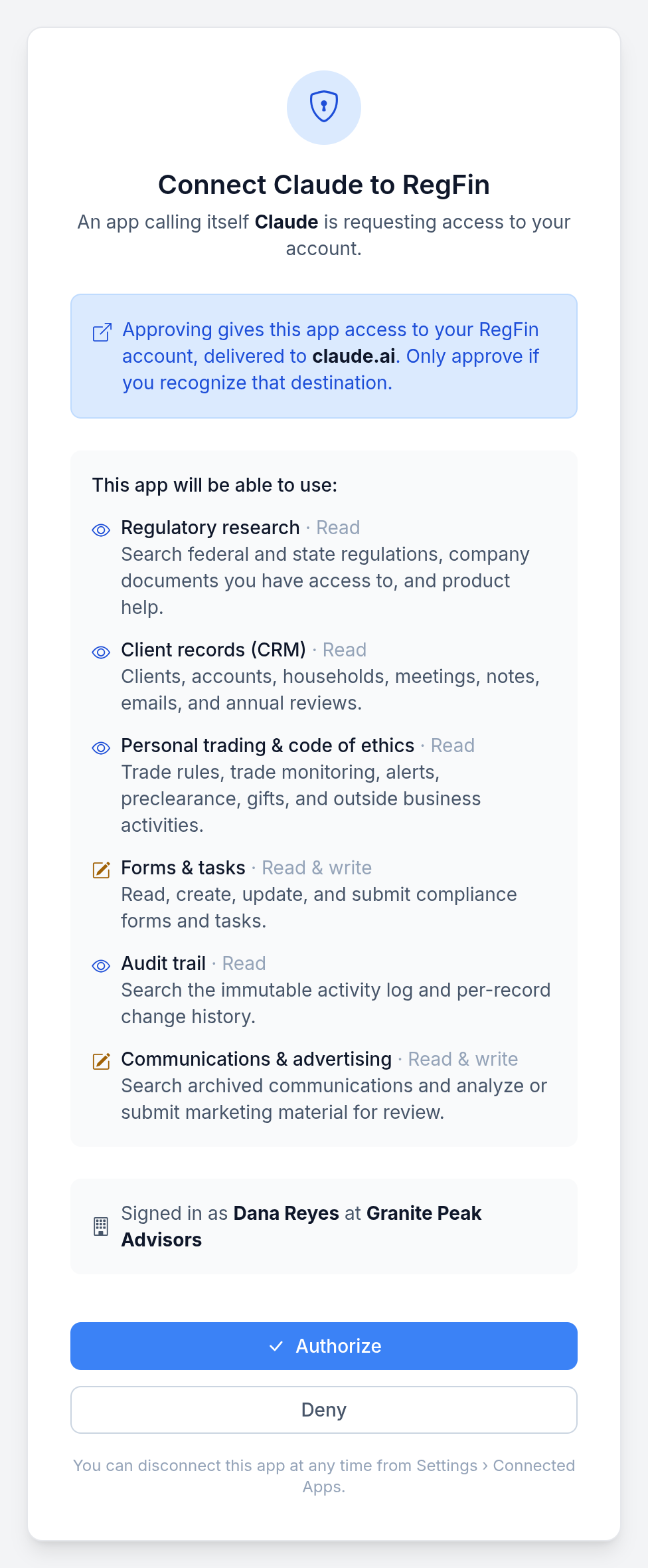
When Claude connects, the person signing in sees exactly which areas it can read and which it can change, before anything is shared.
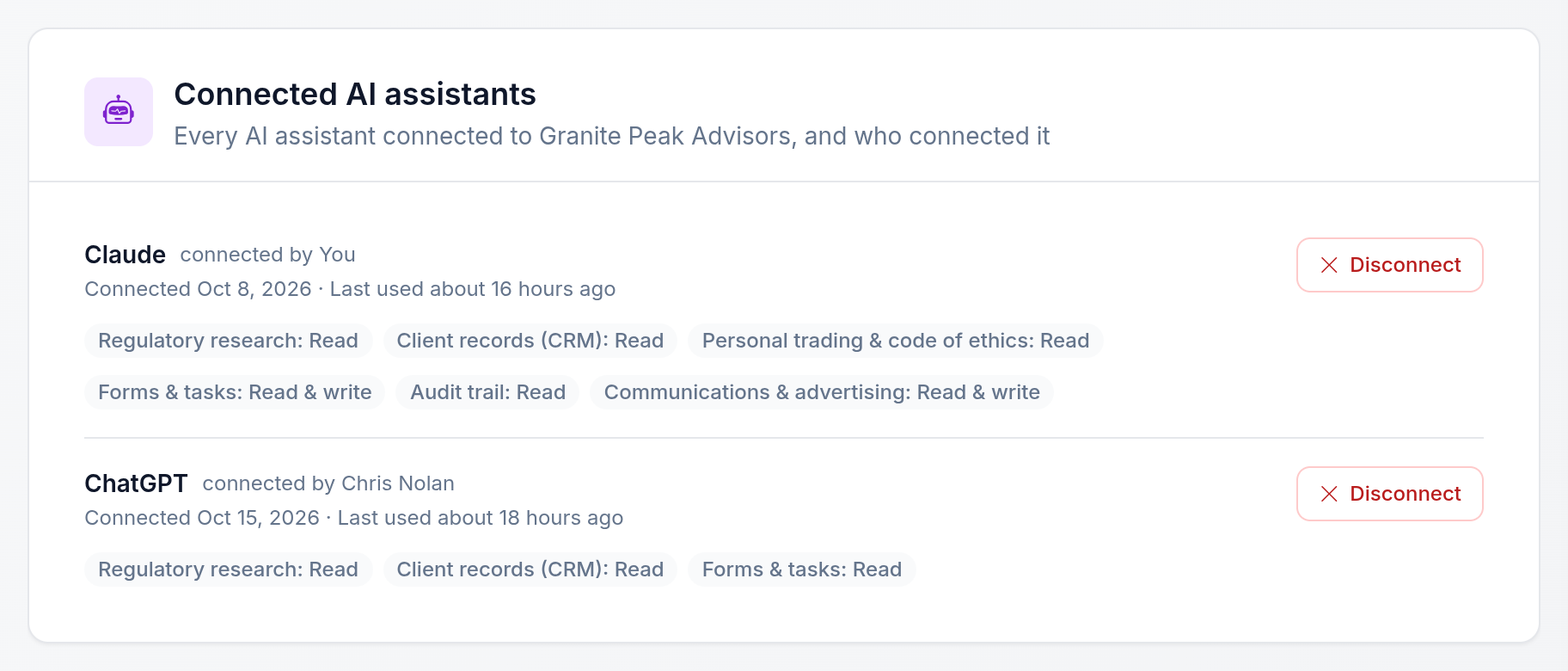
The CCO sees every assistant connected at the firm, who connected it and what it can reach, and can disconnect any of them.
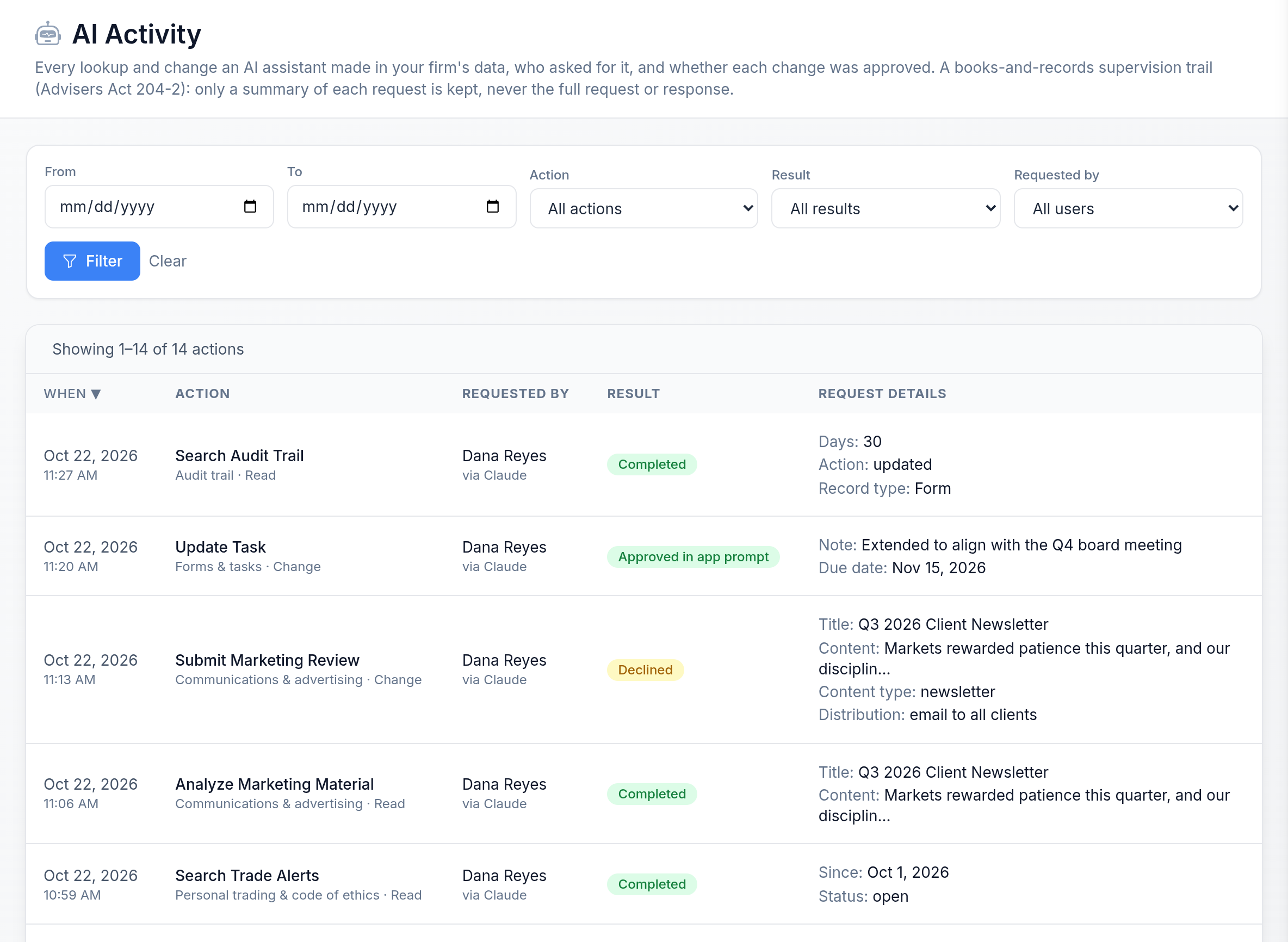
AI Activity shows the CCO each lookup and change an assistant made, whose sign-in it used, and whether a change was approved or declined.
For compliance consultants
A consultant can work across every active firm the consultancy manages from the same assistant. Ask the assistant to list your firms, then name the firm in each request: "In Acme Advisory, which annual review items are still open?" You can move from firm to firm in one conversation, and each request to RegFin is limited to the firm you name and that firm's access rules.
- See what is waiting across the book. Ask for your escalation queue and get every open escalation across your firms, so you know where to start.
- Build once, push to many firms. Create a policy, form, task or trade-rule template and push it to the firms that need it, after a preview shows exactly which firms it reaches. The strictest approval setting among those firms applies to the push.
- The firm still sees your work. Everything a consultant does inside a firm follows that firm's approval rules and lands in its AI Activity under the consultant's name and consultancy.
See how consultants run client programs on RegFin for compliance consultants.
For the broader question of using general-purpose assistants for compliance work, see Can You Connect Compliance Software to Claude or ChatGPT?, and for the program itself, our RIA compliance guide and annual compliance review guide.
The bottom line
Claude for Financial Advisors gives your advisors a capable assistant, and Anthropic has been clear that compliance stays with the firm. Keep the records, oversee the vendors, review the marketing, write and test the policy, and describe your AI use accurately. If those are in place before the first advisor connects a custodian, the rollout is documented by the time an examiner asks about it.
Your advisors are asking for Claude. Bring the questions you'd want answered before you say yes, and book a demo to work through them with our team.
Frequently asked questions
Is Claude for Financial Advisors compliant?
Does Claude keep records of advisor conversations?
What does Claude for Financial Advisors cost?
Do RIAs need Claude Enterprise to use Claude for Financial Advisors?
Does Anthropic train its models on my firm's client data?
Can the Claude compliance skill approve marketing materials?
Does the same apply to ChatGPT?
Sources
- Claude for Financial Advisors (launch announcement, September 14, 2026) — Anthropic
- claude-for-financial-advisors plugin repository (README and skills) — Anthropic (GitHub)
- How to access audit logs — Anthropic
- Compliance API FAQ — Anthropic
- Claude plans and pricing — Anthropic
- Updates to Consumer Terms and Privacy Policy — Anthropic
- OpenAI Compliance Platform for Enterprise and Edu customers — OpenAI
- 17 CFR 275.204-2, Books and records to be maintained by investment advisers — eCFR
- 17 CFR 275.206(4)-1, Investment adviser marketing — eCFR
- 17 CFR 275.206(4)-7, Compliance procedures and practices — eCFR
- 17 CFR Part 248, Regulation S-P (current text) — eCFR
- SEC Adopts Rule Amendments to Regulation S-P (Press Release 2024-58) — U.S. SEC
- Regulation S-P Amendments: A Small Entity Compliance Guide — U.S. SEC
- SEC Charges Two Investment Advisers with Making False and Misleading Statements About Their Use of Artificial Intelligence (Press Release 2024-36) — U.S. SEC
- Division of Examinations, Fiscal Year 2026 Examination Priorities — U.S. SEC
- Division of Examinations, Fiscal Year 2027 Examination Priorities — U.S. SEC
- Notice of Withdrawal of Proposed Regulatory Actions (Release No. 33-11377) — U.S. SEC